










FREE DELIVERY
Get free delivery on orders over £35

Made in britain
Official member of the Made In Britain organisation
BULK SAVE
Automatic discounts of up to 30%
SECURE CHECKOUT
Secure online checkout
FAST DISPATCH
Order before 2pm weekdays for same day dispatch
Disabled & Accessibility Signs
Shop Disabled & Accessibility Signs to help visitors, employees and customers identify accessible entrances, routes, facilities and parking spaces around your premises.
Choose signs for accessible toilets, wheelchair access, ramps, lifts, disabled parking, hearing assistance and refuge points, with a range of sizes and materials for indoor and outdoor locations. Made in Britain by The Sign Shed.
refine your search
-
Disabled Wheelchair Symbol Sign -
Disabled Toilet Sign SS -
No Dogs Except Assistance Sign -
Disabled Parking Space Sign -
Hearing Loop Symbol Sign -
Unisex Toilet Disabled Sign Silver Sq -
Disabled Accessible Parking Only Sign -
Disabled Parking Only Sign -
Accessible Toilet Sign Blue -
Disabled Entrance Sign -
Disabled Parking Sign v4 -
Disabled Reserved Parking Sign -
Disabled Parking Only Sign v2 -
Disabled Toilet Sign Silver Sq -
Disabled Entrance With Left Arrow Sign -
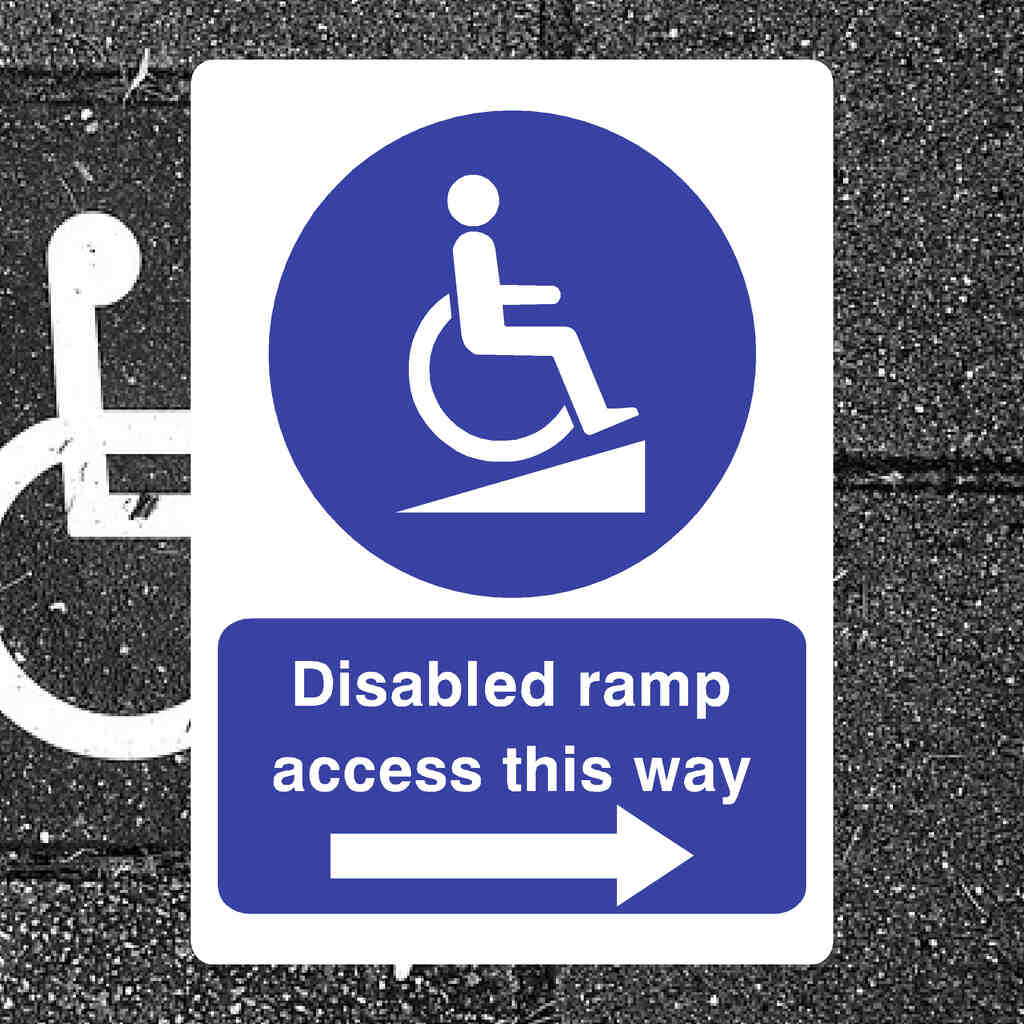
Disabled Ramp Access Right Sign -
Disabled Entrance With Right Arrow Sign -
Disabled Badge Holders Sign -
Unisex Disabled Toilet Sign Silver -
Disabled Toilet Sign Silver Sq v2 -
Disabled Ramp Left Sign -
Disabled Parking Left Sign -
Refuge Point Sign -
Disabled Badge Holders Sign v2
Disabled & Accessibility Signs for UK Premises
Accessibility signage can help visitors, employees and customers identify accessible entrances, routes, toilets, parking spaces and other facilities around a building or site.
Rather than treating each sign as an isolated product, consider the complete journey someone needs to make through your premises.
Can they identify where to park, which entrance to use, how to reach the facility they need and where assistance is available?
Accessible Entrance Signs
Accessible entrances should be easy to identify.
Where the accessible entrance isn't the obvious or principal entrance, directional signage can help people find the correct route without having to ask for assistance.
Consider the journey from the site boundary or car park as well as the sign immediately beside the door.
If somebody reaches an inaccessible entrance before discovering that the accessible entrance is around the building, the wayfinding information has arrived too late.
Accessible Route & Ramp Signs
Directional accessibility signs can help people follow an accessible route through or around premises.
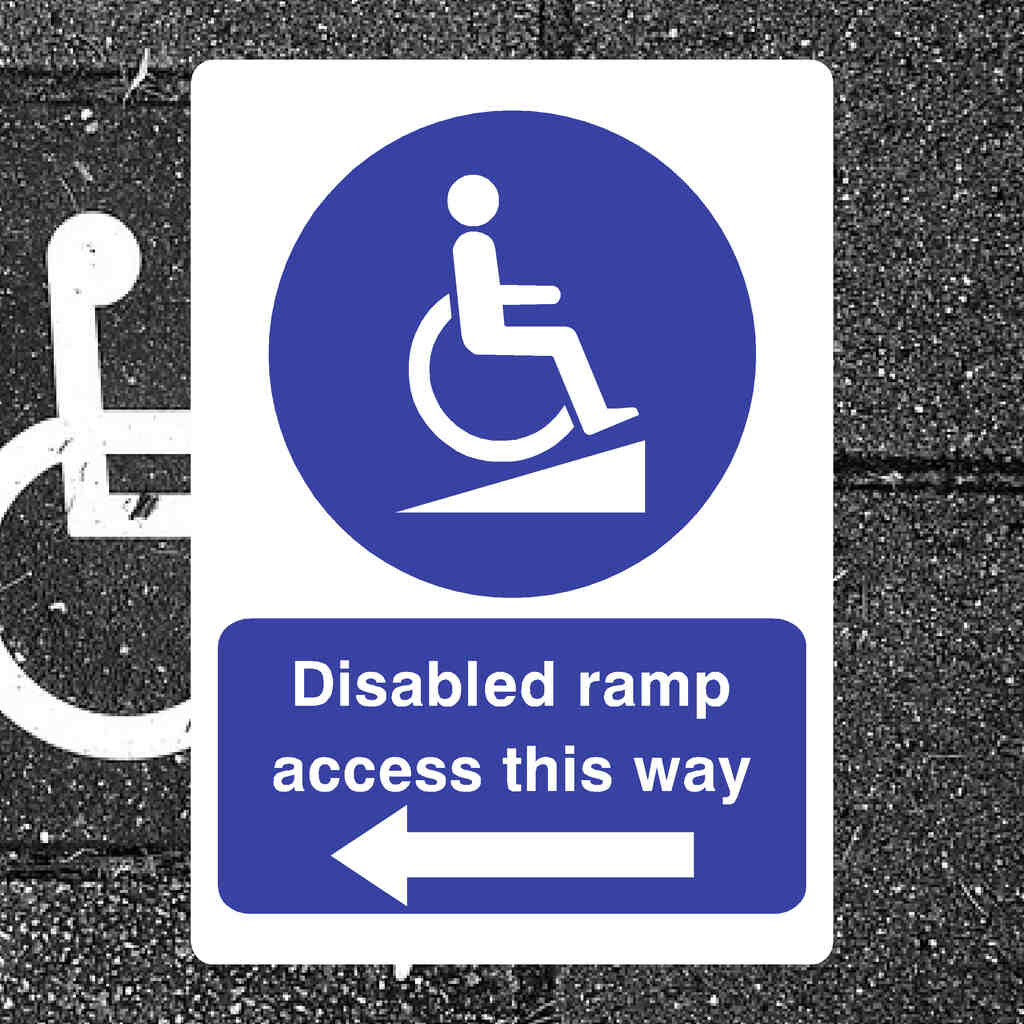
They can be useful where someone needs to find a ramp, alternative entrance, lift or another accessible route.
Position directional signs at the points where someone needs to decide which way to go, particularly at junctions and changes of direction.
Accessible & Disabled Toilet Signs
Accessible toilet signs help identify facilities quickly and clearly.
A door sign may be sufficient where the toilet is immediately visible, but larger buildings can also need directional signs along the route.
Consider whether a first-time visitor could find the accessible toilet without having to ask a member of staff.
Disabled & Accessible Parking Signs
Accessible parking signs can help drivers identify bays intended for disabled or Blue Badge holders.
Depending on the site, signage may be required at individual bays and at earlier decision points where drivers need directions towards accessible parking.
Also consider the route from the parking space to the accessible entrance.
Accessible Lift Signs
Where a lift forms part of an accessible route through a building, signs can help people locate it.
Directional arrows may be useful where the lift isn't immediately visible from the entrance, reception area or main circulation route.
Think about both identifying the lift itself and directing people towards it.
Hearing Loop & Assistance Signs
Accessibility isn't limited to wheelchair access.
Where hearing-assistance facilities such as an induction loop are available, appropriate signage can help visitors identify where they can use them.
Position signs where people are likely to need the information, such as reception desks, counters, meeting rooms or other relevant service points.
Accessible Refuge Signs
Refuge-point signs identify designated refuge locations provided as part of a building's emergency arrangements.
These signs have a different purpose from general accessibility wayfinding and should correspond with the building's actual fire and evacuation arrangements.
Don't use a refuge sign simply as a general wheelchair-access symbol.
Choosing Accessibility Signs
Start with the person using the building rather than the sign catalogue.
Ask:
Where will they arrive?
Can they identify accessible parking?
Can they find the accessible entrance?
Can they follow an accessible route?
Can they find the toilet or lift?
Can they identify available assistance?
Then choose signs that communicate the information at the point where it's needed.
Choosing the Right Size & Material
The appropriate sign depends on its location and viewing distance.
Small door signs may work well for identifying an accessible toilet or facility at close range. Outdoor directional signs may need to be considerably larger.
Also consider whether the sign will be installed indoors or outdoors, the mounting surface, lighting, surrounding visual clutter and how far away it needs to be recognised.
The Sign Shed offers accessibility signage in a range of materials and sizes for different locations.
Made in Britain Accessibility Signs
The Sign Shed manufactures disabled and accessibility signs in Britain for businesses, schools, workplaces, hospitality premises, healthcare environments and other organisations.
Choose signs for accessible entrances, toilets, routes, parking, ramps, lifts, hearing assistance and other facilities in a range of sizes and materials for indoor and outdoor locations.
Disabled & Accessibility Signs FAQs
Get quick solutions to your common accessibility sign buying questions
The signs you need depend on your premises, facilities and how people move around the building or site.
Consider whether visitors can easily identify accessible parking, an accessible entrance, accessible routes, toilets, lifts and any assistance facilities available.
A useful approach is to follow the complete visitor journey from arrival to destination and identify anywhere someone may need additional information or directions.
An accessible entrance can be identified using a clear accessibility sign featuring the recognised wheelchair accessibility symbol.
If the entrance isn't immediately visible, use appropriate directional signs to guide people towards it.
For example, you may need an Accessible Entrance → sign at a decision point followed by an identification sign at the entrance itself.
Position accessible entrance signs where visitors need the information.
This may include the site entrance, car park, main entrance or other decision points along the route.
If the accessible entrance is separate from the main entrance, make sure people can find it before reaching an entrance they cannot use.
Start at the point where visitors arrive and follow the route towards the accessible entrance or facility.
Use directional accessibility signs where the route changes direction or where someone could reasonably be unsure which way to go.
This might include signs between a car park and entrance, towards a ramp, through a building or towards an accessible lift.
An Accessible Entrance sign identifies or directs people towards an entrance that provides accessible access.
An Accessible Route sign helps people follow a suitable route towards an entrance, lift, ramp, toilet or other destination.
The two can work together as part of the same wayfinding system.
The Equality Act 2010 places duties on service providers and employers relating to disability and reasonable adjustments, but it doesn't provide a simple list of signs that every business must purchase.
Appropriate signage and wayfinding may form part of making premises and services accessible, depending on the circumstances.
Businesses should consider the accessibility of the premises as a whole rather than assuming that installing a particular sign automatically makes a building Equality Act compliant.

